How Many People Fit on a Party Bus? The Complete Capacity Guide | LA Nights Party Bus
- LA Party Bus
- May 5
- 16 min read

How Many People Fit on a Party Bus? LA Nights Party Bus
Short answer: party buses in the LA market hold between 10 and 50 passengers depending on the platform. A 10-to-14-passenger Sprinter handles small groups, a 20-to-25-passenger standard party bus is the most-booked tier, a 26-to-34-passenger mid-size fits larger celebrations, and a 35-to-50-passenger luxury coach is the wedding-and-milestone tier. That's the answer that satisfies the search.
The longer answer — the one that actually helps you make a good booking decision — is more complicated than the size brackets suggest, and it's the conversation that almost every party bus website skips. There's a difference between the number of people a bus is rated to hold (the legal capacity, set by the manufacturer and certified by the California Public Utilities Commission for commercial operators) and the number of people who can actually celebrate on that bus without sitting on each other's laps. There's a difference between perimeter seating and forward-facing seating that meaningfully changes how many guests fit comfortably. There's a real reason that booking a 30-passenger bus for 30 guests is a mistake, and an even better reason that booking a 30-passenger bus for 18 guests is sometimes also a mistake.
This guide explains all of it. We've been booking LA party bus rentals across every tier of capacity for years, and the most common booking mistake we see is groups choosing the wrong size for their event — too small for comfort, too large for the energy, or sized correctly on paper but configured wrong for the way the group actually wants to use the bus. Capacity is the first decision you make when booking a party bus, and it's the one that has the biggest impact on how the night goes.
The Real Capacity Brackets in the LA Market
Here are the standard size tiers you'll encounter when shopping for an LA party bus, the typical platforms each tier is built on, and the comfortable-versus-rated capacity of each.
The 10-to-14-passenger tier. These are almost always Mercedes-Benz Sprinter chassis upfitted into either a party Sprinter (LED lighting, sound system, perimeter lounge seating, BYOB-ready) or an executive Sprinter (captain's chairs, privacy partition, corporate finish). The marketed capacity is typically fourteen passengers; the comfortable capacity for a multi-hour booking is twelve. The fourteen-person rating assumes everyone is seated for the entire ride. If your group plans to have anyone standing, dancing, or moving around, the comfortable number drops to ten or eleven. Our Mercedes Sprinter party bus fleet covers this entire tier across five different configurations.
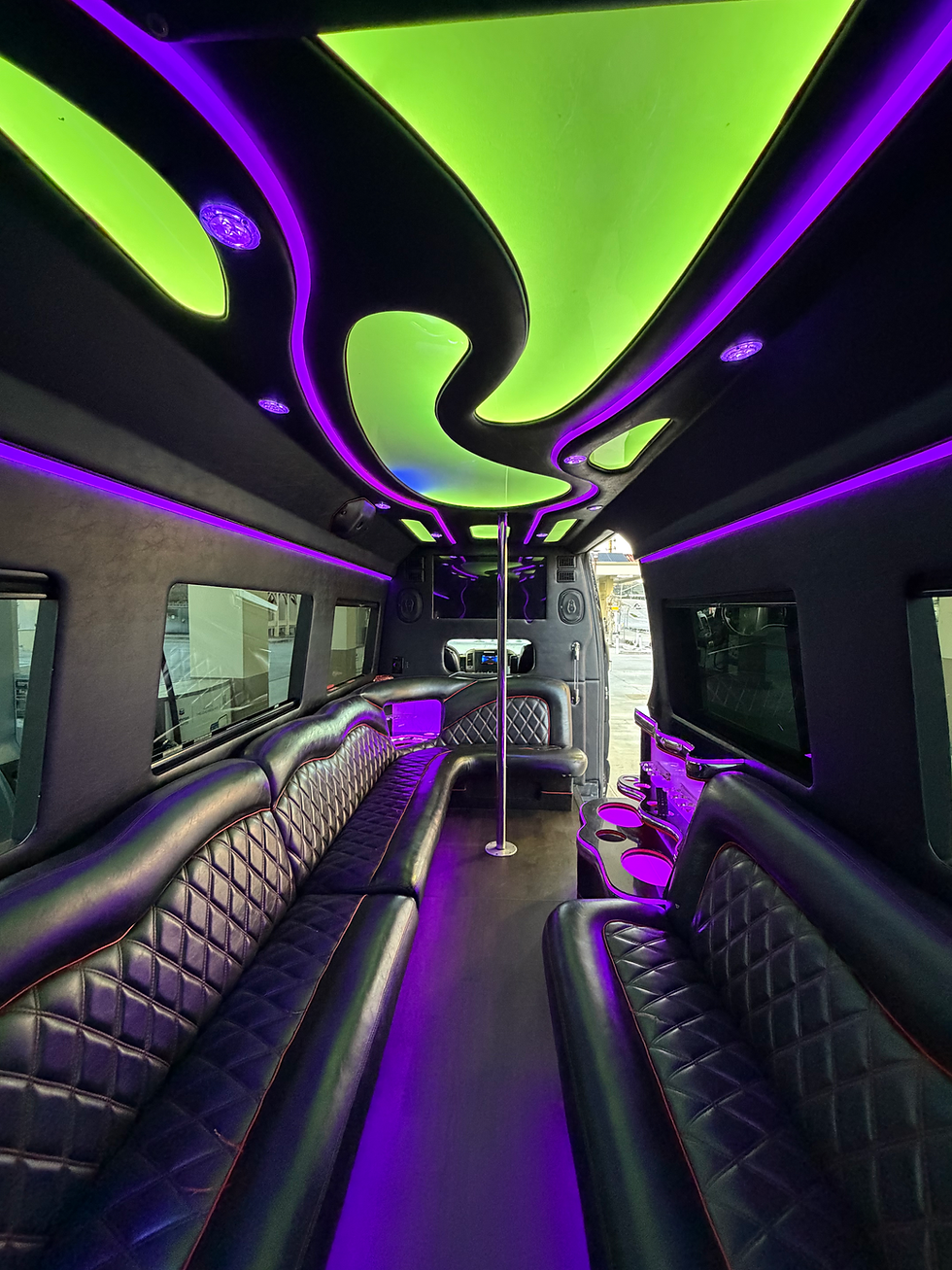
The 20-to-25-passenger tier. This is the most-booked tier in the LA market and the platform most people picture when they hear "party bus." Built on Ford E450 cutaway chassis or similar, with full perimeter leather seating along both walls, hardwood-style party flooring in the center, full LED rig overhead, premium sound system, and a built-in bar area. Marketed capacity is twenty-five; comfortable capacity for an active party is eighteen to twenty-two. At a true twenty-five guests, this bus is functional but tight — guests are pressed together along the perimeter and the dance floor disappears. Most LA operators that quote "twenty-five passenger capacity" are giving you the legal-rated number, not the realistic-comfort number.
The 26-to-34-passenger tier. The mid-size party bus, typically built on a Ford F550 or International chassis with extended length. More dance floor real estate, multiple seating zones, larger sound system tuned to fill a longer cabin. Marketed capacity is thirty-four; comfortable capacity is twenty-six to thirty. This is the right tier for a typical bachelor or bachelorette party of twenty-five guests, a thirtieth birthday with twenty-eight friends, or a corporate event with thirty attendees.
The 35-to-50-passenger tier. The luxury coach tier, built on Freightliner or Ford F750 platforms or repurposed motorcoach chassis. Multiple seating zones, full club-style LED programming, restrooms on select coaches, flat-screen displays. Marketed capacity is fifty; comfortable capacity is thirty-eight to forty-four. This is the wedding shuttle tier, the milestone celebration tier (40th, 50th, retirement parties), and the corporate event tier for large groups.
Across all four tiers, the consistent pattern is the same: the marketed capacity is the legal-rated maximum, and the comfortable capacity is roughly eighty to eighty-five percent of that number. If you book at marketed capacity and your group shows up on the day with everyone in formal attire carrying coats and clutches, you've under-booked the bus. We'll come back to this.
Marketed Capacity vs. Comfortable Capacity: What Operators Don't Tell You
This is the variable nobody else explains plainly. When an LA party bus operator tells you a vehicle holds twenty-five passengers, what they mean is that the vehicle has twenty-five seats — bench positions calculated by the chassis manufacturer and certified by the upfitter. What they're not telling you is the experiential reality of having twenty-five guests packed onto those benches for a four-hour Saturday night booking.
The math on why this matters: standard party bus perimeter seating is benched at roughly eighteen to twenty inches per guest (hip width plus a small buffer). At full rated capacity, every guest is shoulder-to-shoulder with the next guest the entire ride. Add in coats, purses, water bottles, and the inevitable phone-and-camera setup that happens on any modern bachelorette party, and the eighteen-inch personal space gets cut to twelve inches. By hour three of a four-hour booking, "comfortable" is no longer a word any guest would use to describe their experience.
The honest comfortable capacity for any party bus is the rated capacity minus three to five guests. So:
A bus marketed as ten passengers comfortably holds eight to nine.
A bus marketed as fourteen comfortably holds eleven to twelve.
A bus marketed as twenty comfortably holds seventeen to eighteen.
A bus marketed as twenty-five comfortably holds twenty to twenty-two.
A bus marketed as thirty comfortably holds twenty-five to twenty-seven.
A bus marketed as forty comfortably holds thirty-three to thirty-six.
A bus marketed as fifty comfortably holds forty-two to forty-five.
When you book, plan to your comfortable capacity, not the marketed capacity. The standard rule across the industry is to book a bus that's ten to twenty percent larger than your guest count — that rule exists specifically because the marketed numbers overstate real comfort.
Why Capacity Varies Within the Same Size Class
Two thirty-passenger party buses in the same LA fleet can feel completely different inside. The variables that drive that difference matter when you're choosing between similarly-sized vehicles.
Seating layout. Perimeter seating (benches along both walls, facing inward) maximizes seated capacity and creates an open center for standing and dancing. Forward-facing seating (rows of seats facing the front, like a charter bus) accommodates fewer total passengers comfortably but provides more individual personal space. Limo-style configurations (lounge seating in U-shape or wraparound) feel more intimate but reduce capacity by another ten to fifteen percent compared to perimeter benches.
Bar and amenity footprint. A built-in bar area with mounted ice coolers and bottle storage takes up the equivalent of two to three seats. A dedicated dance pole takes up another two seats. An onboard restroom — common on the larger 35-to-50-passenger luxury coaches — takes up the equivalent of four to six seats. These features make the bus better, but they reduce the number of guests the bus can comfortably hold.
Aisle width. Buses configured for active parties have wider center aisles to let guests stand, move, and dance during transit. Buses configured for shuttle or transfer use have narrower aisles to maximize seat count. A 30-passenger party-configured bus has noticeably less seating capacity than a 30-passenger shuttle-configured bus on the same chassis.
Cabin height. Mercedes Sprinter high-roof party buses give you about six feet six inches of standing height. Most Ford-based 25-to-50-passenger party buses give you six feet to six feet two inches. The taller cabin doesn't change seating capacity but does dramatically change how comfortable standing and dancing feels — and that affects how many guests will actually use the open floor space versus staying glued to the seats.
The takeaway is that the number on the operator's website is one piece of information. The more useful question is: how many guests will this specific bus comfortably hold for our specific event type, given the layout and amenities? Any operator worth booking with should be able to answer that on the phone in under a minute.
How to Choose the Right Size for Your Group
Here's the framework we use when a client calls and asks which bus they should book. The answer depends on three variables: guest count, event type, and energy level.
Step 1: Confirm your guest count, then add a buffer. Take your headcount and add ten to fifteen percent. If you're hosting a bachelorette party and your group chat shows fourteen guests committed, plan for sixteen — there's always a "wait, can my sister-in-law come?" addition the week before, and there's always a guest who brings a plus-one without asking. Plan to your inflated number, not your committed number.
Step 2: Match your inflated count to comfortable capacity. Use the comfortable-capacity numbers above, not the marketed-capacity numbers. If your inflated count is sixteen, you need a bus with comfortable capacity of sixteen — which means a bus marketed as twenty passengers, not as fourteen. If your inflated count is twenty-eight, you need a bus marketed as thirty-four, not as twenty-five.
Step 3: Adjust for event type and energy. A wedding shuttle where guests are seated the entire ride from hotel to venue can be booked closer to marketed capacity — guests aren't dancing or moving around, so the eighteen-inch personal space holds fine. A bachelorette party where guests will be standing, dancing, taking photos, and moving between seats throughout the night needs more space than the marketed capacity suggests. Size up one tier for any event where the bus is the venue rather than just the transport.
Step 4: Confirm the layout matches the event. A wedding party in a perimeter-bench-only configuration has a hard time keeping the bridal party photos clean — perimeter seating means everyone is facing each other across the aisle, which is great for conversation but awkward for group portraits. A corporate event in a dance-floor-and-bar configuration is mismatched — the executives don't want a club layout for a client dinner transfer. Ask the operator to confirm the specific layout, not just the seat count.
This four-step framework filters out about ninety percent of the booking mistakes we see. The remaining ten percent are usually edge cases — borderline group counts, multi-event bookings where energy level changes mid-trip, or unusual venue access constraints — that are worth a phone conversation rather than a self-service booking.

Group-Size Decision Table by Event Type
Different events have different ideal capacity curves. Here's how the math works out for the most common LA party bus event types.
Bachelorette parties. Typical guest count: twelve to twenty. The sweet spot is the 20-to-25-passenger standard party bus. At fourteen guests, a 14-passenger Sprinter works for a low-key wine tour but feels cramped for a club crawl. At eighteen guests, you're in the prime zone for the standard 20-25 bus — comfortable, dance-floor active, big enough for the energy. Above twenty-two guests, size up to the 26-34 mid-size for breathing room.
Bachelor parties. Typical guest count: ten to sixteen. Sweet spot: the 14-passenger Mercedes Sprinter or the 20-passenger standard bus. Bachelor groups tend to spread out more than bachelorette groups (they take up more physical space, in our experience), so size up by one tier compared to a bachelorette party of the same headcount. Twelve guys are comfortable in a Sprinter for a brewery crawl but cramped for a Vegas turnaround run — for the longer trip, book the 20-passenger.
Birthday parties. Typical guest count: ten to twenty-five. The decision is driven entirely by age and energy. A thirtieth birthday with fifteen friends doing a dinner-and-club crawl wants the 20-passenger party bus. A fortieth birthday with twenty-five friends doing a wine tour and dinner wants the 26-34 mid-size with limo-style configuration. A sweet sixteen with twenty-five teen guests wants the 26-34 mid-size with full club-style setup.
Wedding shuttles. Typical guest count: thirty to sixty. The ideal here depends on whether the bus is doing the bridal-party transport (smaller, premium, often a Limo Sprinter or a 20-passenger party bus with limo configuration) or the guest-shuttle (larger, capacity-optimized, the 35-to-50-passenger luxury coach). Many LA weddings book both — a Sprinter for the bridal party and one or two larger coaches for the guest shuttle. We coordinate the timing on multi-vehicle wedding bookings as a standard service.
Corporate events. Typical guest count: ten to forty. The 14-passenger executive Sprinter handles VIP transfers and small client dinners. The 20-25 standard bus handles team outings of fifteen to twenty. The 26-34 mid-size handles full department events and conference shuttles. The 35-50 luxury coach handles company-wide events and large client entertainment. Corporate bookings typically prioritize professional finish over party energy — ask for the limo or executive configuration rather than the club configuration.
Wine country day trips. Typical guest count: eight to fourteen for premium tours, fifteen to twenty-five for group celebrations. The Limo Sprinter is the premium choice — comfortable lounge seating, elegant lighting, glassware-ready bar, and the kind of finish that matches an upscale Malibu wine tour. For larger wine groups, the 20-25 standard bus works but the limo configuration matters more than the size.
Concerts and sporting events. Typical guest count: ten to forty. SoFi Stadium events, Hollywood Bowl shows, Crypto.com Arena games, Dodgers games — these bookings prioritize getting a defined group to and from the venue. Capacity should match guest count plus buffer; the experience inside the bus is secondary to the parking-and-traffic savings the bus provides. Match your headcount to the standard-bus or mid-size tier.
Vegas turnaround trips. Typical guest count: eight to fourteen for premium runs, fifteen to twenty-five for group trips. The Passenger Sprinter (14 forward-facing seats) is purpose-built for the four-to-five-hour highway run. For groups above fourteen, the 20-25 standard bus handles the trip with more room but at slightly higher per-mile cost. The LA-to-Vegas party bus booking depends heavily on group size and whether the trip is one-way or round-trip.
The Per-Person Economics of Capacity
Capacity affects price per person dramatically, and the math is worth running before you book. Here's what each tier costs per guest at full comfortable capacity for a typical four-hour Saturday booking, using the published rates from our party bus prices page.
14-passenger Sprinter at $180/hr × 4 hours = $720 base. With 20% gratuity, $864 all-in. Across twelve comfortable guests, $72 per person.
20-25 passenger standard bus at $200/hr × 4 hours = $800 base. With 20% gratuity, $960 all-in. Across twenty comfortable guests, $48 per person.
26-34 passenger mid-size at $215/hr × 4 hours = $860 base. With 20% gratuity, $1,032 all-in. Across twenty-eight comfortable guests, $37 per person.
35-50 passenger luxury coach at $275/hr × 4 hours = $1,100 base. With 20% gratuity, $1,320 all-in. Across forty-two comfortable guests, $31 per person.
The pattern: per-person cost decreases as the bus gets larger, even though the absolute cost increases. A 50-passenger luxury coach is the cheapest party bus in LA on a per-person basis if your group actually fills it — which is exactly why wedding shuttles and large corporate events cluster in the upper tier. Conversely, a 14-passenger Sprinter is the most expensive on a per-person basis but offers the most premium experience.
The trap to avoid: booking a 50-passenger coach for a group of twenty-five "to have extra room" is bad math. You're paying $33 per person across twenty-five guests for a vehicle that costs $31 per person at forty-two guests, and you're getting an experience that feels half-empty — the energy on a half-filled luxury coach is dramatically worse than the energy on a fully-utilized 26-34 mid-size at the same per-person cost.
Right-size the bus to your guest count plus buffer. Don't oversize.
DOT and CHP Compliance: How Capacity Is Actually Regulated
This is the section nobody else writes, and it's the part you actually need to understand if you're booking a party bus in California. Capacity isn't an opinion — it's a regulated number, and the regulator is the California Public Utilities Commission, not the
Department of Transportation.
Every commercial passenger transportation vehicle operating in California must hold a Transportation Charter-Party Carrier (TCP) permit issued by the CPUC. The TCP permit number is the equivalent of a license — it certifies that the operator carries the required commercial liability insurance (typically five million dollars), runs the required driver background checks and drug testing, and operates vehicles that have been inspected and certified for the rated capacity stated on the permit.
The rated capacity for a given vehicle is set by the chassis manufacturer (Ford, Mercedes, Freightliner, etc.) based on the gross vehicle weight rating, the seat-belt count, and the structural seating positions. The CPUC certifies that the operator's specific vehicle meets that rated capacity. Exceeding the rated capacity is a violation that can result in fines for the operator, void the operator's commercial insurance for the booking, and create personal liability for the chauffeur.
Practical implications for you as a renter:
Reputable operators won't exceed capacity, period. If you show up to a 25-passenger booking with twenty-eight guests, the chauffeur will refuse to depart with everyone aboard. That's not the operator being difficult — that's the operator protecting their TCP permit, their insurance, and your safety. Plan your guest count to match your booked capacity, not the other way around.
Standing-while-moving is generally not allowed. California Vehicle Code allows passengers in commercial party buses to stand briefly within the cabin, but the legal expectation is that all passengers are seated when the vehicle is in motion at highway speeds. Most operators enforce a "seated when rolling, standing when stopped or in low-speed transit" policy. The chauffeur has discretion here, but flagrant policy violations can end the booking.
Verify the TCP permit before you book. Every legitimate California party bus operator has a TCP number, and they'll share it on request. You can verify it on the CPUC website in under sixty seconds. An operator that gets cagey when you ask for their TCP number is one to walk away from. Our TCP information is available on request — call us and we'll provide it.
Understand the difference between "fits" and "is rated for." A bus that physically holds thirty people is not the same as a bus that's TCP-permitted for thirty passengers. Some operators advertise capacity numbers that exceed their certified rating — that's a red flag. Ask explicitly: "What's the TCP-certified capacity for this specific vehicle?"
This stuff matters more than people realize. The cost of a TCP-permitted, fully-insured operator is somewhere between identical and ten percent higher than an unlicensed operator. The cost of an accident on an unlicensed bus is everything — your medical bills, your group's medical bills, and your legal exposure as the booking party are all in play if the operator's coverage isn't valid.
Common Capacity Mistakes (and How to Avoid Them)
Five mistakes we see regularly:
Booking to your committed headcount instead of your inflated headcount. You've got fifteen guests committed in the group chat. By the day of the event, you've got eighteen — three plus-ones, two late additions, and one cousin you forgot to count. If you booked a bus rated for fifteen, you're now over capacity and the chauffeur is going to send three people home in Ubers. Always inflate by ten to fifteen percent.
Assuming "twenty-five passenger" means twenty-five comfortable guests. It means twenty-five seated guests packed shoulder to shoulder. For an active party, twenty comfortable guests is the realistic number. Size up.
Oversizing for "extra room." Booking a 50-passenger coach for a group of twenty-five doesn't give you "extra room" — it gives you a half-empty bus where the energy feels off. The dance floor is too big, the sound system is tuned for a fuller cabin, and the photos look weird with empty seats in the background. Match capacity to comfortable headcount, not to the largest bus available.
Mismatching layout to event type. A perimeter-seated club-style party bus is wrong for a corporate dinner shuttle. A limo-configured wine-tour bus is wrong for a Hollywood club crawl with twenty-two bachelorette guests. Confirm the specific configuration with the operator before booking, not just the seat count.
Not asking about the TCP-certified capacity. Some operators advertise capacity numbers that exceed the certified rating on the bus's CPUC paperwork. If the booking is tight to the advertised number, ask explicitly: "What does the TCP permit say the legal capacity is?" An honest operator will give you the number directly.
Edge Cases and Borderline Group Sizes
Three edge cases that come up regularly:
Groups of fourteen to sixteen. This is the awkward zone between Sprinter capacity and standard-bus capacity. Fourteen guests fit a Sprinter at marketed capacity but feel cramped for an active four-hour party. Sixteen guests don't fit a Sprinter, period. The right call here is the 20-passenger standard bus — gives you breathing room, real dance-floor space, and the full LED-and-sound rig that a Sprinter doesn't quite match. The per-person cost difference is usually ten to fifteen percent, and the experience difference is significantly larger.
Groups of twenty-three to twenty-six. The 25-passenger standard bus is rated for twenty-five but comfortable at twenty to twenty-two. The 30-passenger mid-size is rated for thirty-four and comfortable at twenty-six to thirty. If your inflated headcount is twenty-three or twenty-four, the standard bus is acceptable but tight. Twenty-five or twenty-six guests should size up to the mid-size. The energy difference between twenty-six guests in a 25-passenger bus (cramped) versus a 30-passenger bus (perfect) is night and day.
Groups above fifty. California regulations and most LA fleets cap the largest single party bus at fifty passengers. For groups above fifty, the move is multiple buses running coordinated routes — a 50-passenger luxury coach plus a 25-passenger standard bus, for example, handles seventy-two comfortable guests. We coordinate multi-vehicle bookings as a standard service for weddings, corporate events, and large milestone celebrations. The total per-person cost is comparable to a single hypothetical 75-passenger bus that doesn't exist in most fleets.
Capacity FAQs
What's the maximum capacity of a party bus in LA? The largest buses in the LA market hold fifty passengers, certified by their TCP permits and chassis ratings. Some custom-built coaches push to fifty-five or sixty, but those are rare and the comfortable capacity for a multi-hour party is closer to forty-five even on the largest platforms. For groups above fifty, multiple coordinated buses are the standard approach.
Can I pack twenty-eight people into a 25-passenger bus? No. The chauffeur will refuse to depart with passengers exceeding the TCP-certified capacity, full stop. This is a legal and insurance matter, not a flexibility issue. Plan your guest count to match your booked capacity.
How do I know if my chosen bus is the right size? Apply the four-step framework above: confirm your committed headcount, inflate by ten to fifteen percent, match the inflated number to comfortable capacity (eighty to eighty-five percent of marketed), and adjust by one tier up if the event involves significant standing or dancing.
What if my group size changes the week before the event? Tell the operator immediately. If your headcount went up and you're now over capacity, the operator can usually upgrade you to the next bus size for a price difference (sometimes free if the larger bus is available; usually a 10-20% upgrade fee). If your headcount went down, there's typically no refund for unused capacity — you booked the bus, you're paying for the bus.
Are seat belts required on a party bus? California law requires seat belts at every certified passenger position on commercial buses. Whether they're worn during the trip is a different question — at highway speeds, yes; in low-speed urban transit between venues, the law is more permissive. The chauffeur enforces the policy on a case-by-case basis.
What's the difference between a 14-passenger Sprinter and a 14-passenger
limousine? Cabin format. The Sprinter is a high-roof van with stand-up height (six feet six inches) and lounge or captain-chair seating. A 14-passenger limousine — increasingly rare in the LA market — is a stretched sedan body with low ceilings (you can't stand) and forward-facing or limo-style perimeter benches. The Sprinter has effectively replaced the stretch limo for most modern LA group bookings.
Do amenities like a dance pole or onboard restroom reduce capacity? Yes. A dance pole takes up the equivalent of one to two seats; an onboard restroom takes the equivalent of four to six seats. The marketed capacity for a bus with these amenities should already account for the reduction, but it's worth confirming with the operator.
Final Thoughts: Capacity Is the First Decision That Matters
Most party bus booking conversations start with date and budget. They should start with capacity. The size of the bus you book determines the energy of the event, the per-person economics, the layout you can choose, and whether the guests you're hosting walk off the bus saying "that was incredible" or "I'm glad to be off that thing."
Get the capacity right and the rest of the booking decisions get easier. Get it wrong and no amount of LED rig or premium sound system saves the experience. The operators worth booking with will help you size correctly — sometimes recommending up, occasionally recommending down, always with an explanation of why. The operators that just take your booking at whatever size you initially asked for, without asking about your event type or your inflated headcount, are not optimizing for your experience.
If you're planning an event in LA and trying to figure out the right bus for your group, call us at 626-616-6242. We'll talk through the capacity decision with you in five minutes — committed headcount, inflated headcount, event type, energy level, layout preference — and recommend the right tier with the right configuration. Then we'll quote it transparently against our published pricing so you can compare it apples-to-apples against any competitor in the market.
The right answer to "how many people fit on a party bus" is the bus that fits your specific group on your specific event date. Everything else is just brackets on a website.

Comments