Inside the Party Bus | LA Nights Party Bus
- LA Nights PArty Bus
- Jan 30
- 20 min read

Updated: May 8
Inside a Party Bus: The Complete Interior Tour by Vehicle Tier
If you've never been inside a party bus, the photos on most operator websites won't tell you what you actually need to know. Every site shows the same three angles — wide-angle perimeter seating shot, ceiling LED detail, and a bar area close-up — and every site captions them with the same generic features list (leather seats, LED lights, sound system, dance floor, bar, climate control). What's missing from the entire SERP is the operator-side detail: which features actually matter, how the interior changes by vehicle tier, what's standard versus what's marketing language, and what the inside of a party bus actually looks like when you're booking the specific vehicle that shows up at your door.
This guide is the interior tour every other blog skips. We've operated LA party bus rentals across every fleet tier — from 14-passenger Mercedes Sprinters to 50-passenger luxury coaches — for years. Every component on this page is something we've installed, repaired, replaced, or upgraded across our actual fleet. The descriptions match what you'll see when the bus pulls up at your address.
If you're trying to figure out what to expect inside a party bus before you book, what the difference is between a 25-passenger and a 40-passenger interior, what makes a "premium" party bus actually premium versus marketing-only, or what should be standard in any reputable LA operator's vehicle, this is the operator-side walkthrough you need. The 30-second answer is at the top; the full tier-by-tier tour follows.
Quick Answer: Inside a Party Bus at a Glance
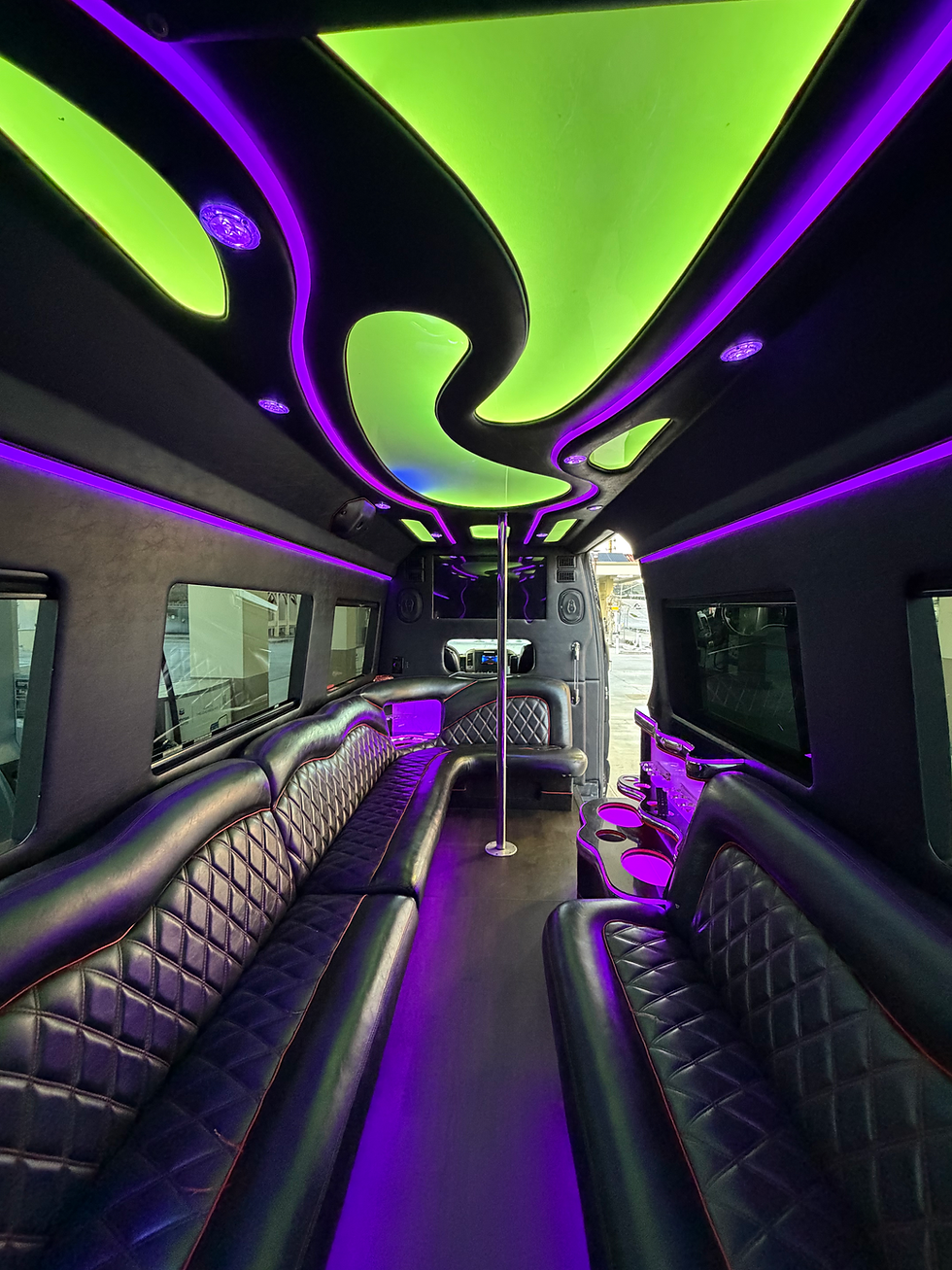
What's inside a typical party bus: wraparound leather perimeter seating, color-changing LED lighting on ceiling and floor, a Bluetooth-connected premium sound system with multiple speakers and subwoofers, hardwood-style party flooring in the center for standing and dancing, a built-in bar area with mounted ice coolers, climate control with rear-zone independence, privacy-tinted windows, and a privacy partition between the chauffeur compartment and the passenger cabin.
What's standard on most LA fleets: Bluetooth audio, LED color-changing lighting, leather seating, climate control, ice-stocked coolers, USB charging at multiple points.
What's premium and only on some buses: onboard restroom, dance pole, karaoke microphones with the sound system, flat-screen displays wired to gaming consoles, fiber-optic ceiling effects, smoke or haze machines, multiple seating zones (lounge + dance floor as separate spaces).
What capacity affects: 10-14 passenger Sprinters have stand-up height (6'6") but smaller dance space. 20-25 passenger standard buses have full club-style setup but tighter aisle. 26-34 mid-size buses have multiple zones. 35-50 passenger luxury coaches add restrooms and separate seating areas.
What you should specifically ask before booking: the year and condition of the LED system, whether the Bluetooth pairing is reliable (older systems drop connection), whether the ice coolers come pre-stocked, whether the climate control has a rear zone independent of the chauffeur compartment, and whether there's a working USB outlet at every seat or only at limited points.
Booking: Call LA Nights Party Bus at 626-616-6242 for a transparent quote against published rates and confirmed vehicle assignment, or browse our LA party bus fleet.
The 8 Standard Components Inside Every Reputable Party Bus
Before we tier the differences, here's what's standard across every party bus that should be in service in the LA market. If any of these are missing or visibly worn out on the bus that shows up at your door, that's information about the operator you booked.
Wraparound leather perimeter seating. Every party bus uses leather (or high-grade vinyl that looks like leather) bench seating along both walls of the cabin, facing inward. This layout maximizes dance floor space and creates a social configuration where guests face each other across the aisle rather than staring at the back of someone else's head. Bench seating is upholstered in black, white, or two-tone designs depending on the bus. Stitching should be intact, no tears, no visible wear on the contact surfaces. A bus with cracked or peeling leather is a bus that's been operating without proper maintenance — that's a quality signal worth paying attention to.
Color-changing LED lighting on ceiling and floor. The defining visual feature of a party bus interior. LED strip lighting runs along the ceiling perimeter, the floor edge, and often the cabinetry. Reputable operators use programmable LED systems that can run color cycles, beat-sync to the music, or hold steady on a single color. Older systems (pre-2018) often only have basic color modes; newer systems (2020+) can be controlled from a tablet or smartphone with custom programming. Ask about the LED system's age if it matters for your booking — Sweet 16s and bachelorette parties want the full programmable rig; corporate transfers want the option to hold steady on white or a single mood color.
Premium Bluetooth-connected sound system. Multiple speakers (typically 6-12 across the cabin), one or two subwoofers, and a Bluetooth receiver paired to whichever guest's phone is running the playlist. Modern systems support multi-device pairing so the playlist can be passed around without re-pairing. The volume level should be loud enough to fill the cabin at full energy and quiet enough to allow conversation when dimmed — that's a tuning question, not a hardware question, and operators who tune their sound systems properly are operators who care.
Hardwood-style party flooring in the center aisle. The middle of the bus cabin is left open as a standing/dancing area, with hardwood-style flooring (engineered laminate, not actual hardwood) that holds up to spilled drinks, dancing in heels, and the occasional dropped phone. The flooring should be clean, level, and not visibly damaged.
Built-in bar area with mounted ice coolers. A countertop or shelf along one section of the cabin (usually the rear) with cup holders, ice coolers built in or mounted, and storage for glasses or cans. The bar comes pre-stocked with ice for adult bookings under our BYOB-allowed party bus rental configuration. Ice coolers should be functional (not melted, not improvised), and the countertop should be clean before pickup.
Climate control with at least two zones. Air conditioning and heating that can be controlled independently from the chauffeur's compartment and the passenger cabin. The rear of the cabin (where guests are dancing under hot LED rigs) needs more cooling than the front; a single-zone system that only heats or cools the entire bus is a sign of an older or under-spec'd vehicle.
Privacy-tinted windows. Standard automotive privacy tint on all passenger windows, dark enough to obscure the interior from outside view but not so dark it violates California Vehicle Code window-tint regulations on commercial vehicles. The tint serves two purposes: privacy for guests inside, and reduced sun load to keep the cabin cooler.
Privacy partition between chauffeur and passenger cabin. A solid divider (usually with a small communication slider window) between the chauffeur's compartment and the passenger cabin. This isn't required by law in California but is standard on every party bus in our fleet. The partition gives guests privacy and gives the chauffeur acoustic separation from the music level the cabin runs at full volume.
These eight components define what "party bus standard" means. Anything below this is a downgraded vehicle; anything above this is a premium tier we'll cover next.
Inside a 14-Passenger Mercedes Sprinter Party Bus (The Sprinter Tier)
The smallest configuration in the LA party bus market is the 14-passenger Mercedes-Benz Sprinter, custom-upfitted into a luxury group transport vehicle. The interior is fundamentally different from a larger party bus — it's tighter, more intimate, and built for a specific use case (groups of 8-14, premium positioning, accessing venues that larger buses can't fit).
Cabin dimensions. The high-roof Sprinter configuration gives you about six feet six inches of interior standing height, which means a 6'2" guest can stand upright without ducking. The cabin length is approximately 14 feet of usable interior space, the width is roughly six feet, and the seating wraps the perimeter in a U-shape configuration that maximizes the available floor area.
Seating layout. The Party Sprinter configuration runs lounge-style benches along three walls (driver-side, rear, passenger-side) with the entry door breaking the symmetry. The seating is plusher than the standard party bus tier — typically two-tone leather with deeper cushioning. Some Sprinter variants run captain's chairs (Executive Sprinter configuration) instead of benches; that's a different product built for corporate use, not party use.
LED rig. Sprinter LED rigs are tighter to the ceiling and walls than larger buses because the cabin space is smaller. Color-changing perimeter LEDs on the ceiling, floor edge LED strips, and accent lighting in the cabinetry. The effect is more "private nightclub VIP booth" than "rolling dance floor."
Sound system. Sprinter sound systems use 4-6 speakers tuned to the smaller cabin volume, with one or two subwoofers under the seating. The sound quality is often better than larger buses because the smaller cabin is acoustically easier to fill — there's less air to push and fewer reflections to manage.
Bar area. Sprinter bars are compact — typically a single section of countertop near the rear with built-in coolers and cup holders for the entire group. Less storage than a larger bus, but enough for a group of 14's BYOB beverages for a 4-hour booking.
Floor space. The Sprinter's center floor is the limiting factor. The aisle is roughly three feet wide, which is enough for guests to stand and move during the ride but not enough for a true "dance floor" experience. The Sprinter is built for sitting-and-socializing energy with brief standing moments, not for a full standing-and-dancing format.
What makes the Sprinter interior special. The Mercedes-Benz chassis delivers ride quality dramatically smoother than Ford-based party buses, which means the interior experience is more comfortable across LA's notoriously uneven streets. Combined with the stand-up cabin height and the upscale finish, the Sprinter delivers a "private jet cabin on wheels" feel that the larger party bus tiers don't quite match. For the deep dive on the Sprinter platform and its five distinct configurations (Party, Limo, Executive, Black Car, Passenger), see our complete Mercedes Benz party bus guide, or browse our dedicated Sprinter van rental fleet page for current pricing and configuration availability.

Inside a 20-25 Passenger Standard Party Bus (The Most-Booked Tier)
The 20-25 passenger party bus is the workhorse of the LA fleet — most-booked, most-photographed, the format people picture when they hear "party bus." The interior is a different category of vehicle from the Sprinter — built on a Ford E450 cutaway chassis with a fully custom party-bus body, and configured for the full club-style energy.
Cabin dimensions. Approximately 22-25 feet of usable interior length, six feet of interior standing height (notably less than the Sprinter's six-six), and roughly seven feet of width. The cabin feels longer and rangier than the Sprinter's compact intimacy.
Seating layout. Wraparound leather perimeter seating along both walls and across the rear, with the front section near the chauffeur partition typically configured for additional bench seating or sometimes a forward-facing pair of seats. The center aisle is roughly four feet wide — meaningful dance floor space, in contrast to the Sprinter's three-foot standing aisle.
LED rig. Standard party bus LED installations use 8-12 ceiling LED zones, full perimeter floor lighting, and accent lighting on the bar area and cabinetry. Some buses add fiber-optic ceiling effects (the "starlight" look), strobe lighting, and laser projectors for bachelorette and Sweet 16 events. The LED programming options on this tier are typically more elaborate than the Sprinter — beat-sync, color cycles, single-color holds, and custom modes.
Sound system. Larger sound systems with 8-12 speakers and 2-4 subwoofers. The cabin volume is bigger so the system needs more output to fill the space at full energy. Bluetooth, AUX, and sometimes microphones for karaoke setups (more on this in the premium tier section).
Bar area. The standard bus bar is meaningfully larger than the Sprinter's — typically a 3-4 foot section of countertop with multiple coolers, more cup holders, and storage shelving for cans, bottles, and glasses. The bar is positioned at the rear of the cabin, opposite the entry door, which is the standard layout that lets guests reach drinks without crossing the dance floor.
Floor space. The four-foot center aisle plus the open rear floor area near the bar gives this tier real dance floor space. Twenty guests can stand and move comfortably; the dance floor doesn't disappear at full capacity. This is what people mean when they describe the "party bus dance floor" experience — it lives at this tier and above.
Restroom. The 20-25 passenger tier typically does not include an onboard restroom. Bathroom stops happen at planned venues. For longer routes (Palm Springs, Vegas, wine country), the lack of an onboard restroom is the main limitation that pushes groups up to the next tier.
What makes this tier the standard. It's the price-to-experience sweet spot. The 14-passenger Sprinter costs more per person; the 35-50 passenger luxury coach is overkill unless your group is filling it. The 20-25 passenger standard bus delivers full club-style party bus energy at the per-person cost most groups can justify, and it's the workhorse for bachelorette party bus and bachelor party bus bookings — most groups in the 18-22 guest range fit perfectly in this tier. For current rates by tier, see our party bus prices page; for the complete capacity-versus-comfortable-fit decision tree, see our party bus capacity guide.
Inside a 26-34 Passenger Mid-Size Party Bus
The mid-size party bus expands every dimension of the standard 20-25 tier. Built on a Ford F550 chassis or similar extended platform, this tier is configured for groups that need more dance floor real estate, more seating zones, and louder sound systems tuned to a larger cabin.
Cabin dimensions. Approximately 28-32 feet of usable interior length — five to seven feet longer than the standard tier. Six feet to six feet two inches of standing height. Seven to eight feet of width. The bus feels significantly bigger inside, with room to create distinct seating zones rather than a single perimeter loop.
Seating layout. Two seating zones are standard at this tier: a front lounge area near the chauffeur partition (typically four to eight seats configured in a U-shape facing each other) and a rear party area with full perimeter seating wrapping the back wall and side benches. Some configurations add a center divider between zones, but most run as a continuous interior with two distinct energy zones.
LED rig. Bigger LED installations with 12-16 ceiling zones, perimeter and accent lighting throughout, and often a dedicated dance floor LED panel that lights up the center aisle. Some mid-size buses add ceiling-mounted laser projectors and DMX-controllable moving heads (the kind of programmable lighting that makes the bus look like an actual nightclub).
Sound system. Sound systems at this tier use 12-16 speakers and 4-6 subwoofers tuned to the larger cabin. The output is louder, the bass is more pronounced, and the system has the headroom to run at full energy without distortion. Microphone inputs are common at this tier — the karaoke setup that didn't work in a Sprinter cabin works perfectly in a mid-size bus.
Bar area. Larger bar sections, sometimes split across two areas (a primary bar at the rear and a secondary cooler/cup-holder station near the front). Multiple coolers, more storage, and sometimes a small fridge in addition to ice coolers.
Floor space. Five to six feet of aisle width with significant dance floor area in the center and rear. This is the tier where guests can genuinely dance without bumping into each other at full capacity.
Restroom. The mid-size 26-34 passenger tier sometimes includes an onboard restroom (typically a small enclosed compartment near the rear), but it's not universal. Confirm restroom availability with the operator at booking — it matters for any trip over four hours.
What makes this tier the right call. Group sizes of 22-30 outgrow the standard bus tier. The mid-size bus delivers the room those groups need without jumping all the way to the 50-passenger luxury coach price point. It's the natural step-up tier for bachelor parties, bachelorettes, and milestone birthday party bus bookings where the guest list crosses 22-25 people. For Sweet 16 and tween/teen birthday bookings — which fall under different alcohol-policy rules than adult events — see our kids party bus rental guide.
Inside a 35-50 Passenger Luxury Coach
The largest single party bus available in the LA market. Built on a Freightliner or Ford F750 platform (or repurposed motorcoach chassis), the luxury coach is a fundamentally different product from the smaller tiers — it's closer to a private nightclub on wheels than a party bus.
Cabin dimensions. Approximately 35-42 feet of usable interior length, six feet two inches to six feet four inches of standing height (taller cabin space than mid-size), and eight feet of width. The bus has true motorcoach dimensions with a party bus interior buildout.
Seating layout. Three or four distinct zones are standard at this tier. The front lounge area (executive seating for VIP guests or older relatives at weddings), a middle social/dance zone with U-shaped perimeter seating, and a rear bar/lounge area sometimes configured as a separate "VIP back booth" with elevated platform or enclosed seating. The configuration encourages the natural energy fragmentation that happens with 40-plus guests — different sub-groups can occupy different zones without crowding each other.
LED rig. Large-scale LED installations that genuinely match nightclub production specs. 16-24 ceiling zones, full perimeter and floor lighting, dedicated dance floor LED panel, ceiling-mounted DMX-controllable moving heads, laser projectors, and sometimes haze or fog machines for the full club atmosphere. The LED programming is typically run from a dedicated tablet or DMX board with preset modes for different event types (wedding, bachelor, corporate, Sweet 16).
Sound system. Full-scale sound systems with 16-24 speakers, 6-10 subwoofers, multiple amplifier zones tuned to different sections of the cabin, and microphone inputs for karaoke or wedding-toast use. The system output rivals small nightclubs and is capable of filling the entire cabin at concert-level volume without distortion.
Bar area. Multiple bar zones — typically a primary bar with full glassware setup and a secondary bar/cooler station in the rear lounge. Multiple coolers, dedicated fridges (not just ice coolers), and sometimes small ice machines built into the bar countertop. Storage for the BYOB volume that 40-plus guests bring on a four-hour booking.
Floor space. Genuine dance floor real estate — six to eight feet of central floor area with the rear lounge providing additional standing room. Forty guests can dance simultaneously without crowding.
Restroom. Onboard restrooms are standard at the 35-50 passenger luxury coach tier. The restroom is typically a fully enclosed compartment with a marine-style toilet, sink, and usually an LED light. The restroom is the single biggest functional difference between this tier and the smaller tiers — it's what makes the luxury coach the right call for wedding shuttles, full-day bookings, and any trip where multiple bathroom stops would otherwise eat into the route.
What makes this tier the wedding-and-milestone-event standard. Forty-plus guest lists need this format. Below that count, you're paying for empty seats. At forty-plus guests, the per-person cost actually drops below the smaller tiers because the bus rate is spread across more guests. Wedding parties, milestone celebrations (40th, 50th birthdays, retirements), and corporate events of 35-plus people are the natural use cases. The luxury coach is also the right call for long-distance trips where the onboard restroom is non-negotiable — LA-to-Palm Springs party bus runs and Las Vegas turnaround trips both work better in this tier than smaller buses. For corporate VIP transfers that don't need full club setup, our black car service and Executive Sprinter line are usually the better call.
Premium Features That Aren't Standard (And Why They Cost More)
Across every tier, there are features that some operators include and some don't. These are the upgrades worth knowing about before you book.
Onboard restroom. Standard on the 35-50 passenger luxury coach tier. Sometimes available on the 26-34 mid-size tier. Almost never available on the 20-25 standard tier or the 14-passenger Sprinter. The restroom adds significant cost (roughly $25-40/hr to the rental rate) but is non-negotiable for trips over four hours and for groups that include older guests, pregnant guests, or anyone who'd rather not stop at a gas station bathroom.
Dance pole. A vertical pole mounted from floor to ceiling in the center of the dance floor area. Common on bachelorette-party-configured buses, less common on corporate or wedding-shuttle buses. The pole takes up the equivalent of one to two seats and reduces the marketed capacity slightly. If your group wants the pole, ask specifically — not all buses in any operator's fleet have one.
Karaoke microphones with the sound system. Wired or wireless microphones connected to the sound system, with a phone-app or onboard interface for queuing karaoke tracks. Standard on most mid-size and luxury coach buses, optional on standard 20-25 tier, almost never on Sprinters. The setup matters for wedding parties (the toast moment), corporate events (announcements), and any event where the sound system needs to amplify a voice rather than just music. Karaoke also unlocks one of the highest-energy party bus games — Karaoke Battle works on any bus with a microphone-equipped sound system.
Flat-screen displays. Mounted flat-screen TVs (typically 32"-42") at the front and rear of the cabin, wired to gaming consoles, streaming devices, or the sound system for music video display. Standard on luxury coach tier, optional on mid-size, occasional on standard. Useful for corporate event presentations, sports event group viewing, or longer routes where a movie can fill drive time.
Fiber-optic ceiling effects. The "starlight headliner" look — fiber-optic strands embedded in the ceiling that create the impression of a star field. Standard on luxury coaches, optional on mid-size. Adds nothing functional but adds significantly to the photo content guests take during the ride.
Smoke or haze machines. Standard on most luxury coaches with full DMX lighting setups. The haze enhances the LED effects (the light beams become visible) and creates the full nightclub atmosphere. Some buses have CO2 cannons for special-effect drops. Useful for bachelorette and Sweet 16 events; overkill for most other bookings.
Dedicated VIP booths. On luxury coaches, an enclosed or elevated seating area separated from the main cabin floor. The "back of the bus VIP" experience for the bride, the birthday guest of honor, or executive VIP transport.
Wireless charging pads. Built into seat-side cup holders or armrests on newer buses (2022+). Useful for keeping phones charged across a 4-6 hour booking without bringing your own cable.
Multi-zone climate control. Beyond the standard rear-zone independence, some luxury coaches add four-zone climate control (front-driver, front-passenger, mid-cabin, rear-cabin). Matters for buses that mix VIP seating with full-energy dance floors at different temperatures, and for long-route bookings like Malibu wine tours where the bus is moving through varying outside temperatures from coastal to canyon to desert.
Custom playlist/lighting integration. On the highest-end buses, the LED system and sound system can be programmed in advance from a phone app — set the lighting cue list to match specific songs, queue beat-sync transitions, and run the entire bus visual show from a guest's phone. Standard on a small percentage of luxury fleets; ask if it matters.
What to Ask Before You Book to Verify the Interior
The interior photos on most operator websites are stock photos or marketing shots — not necessarily of the specific bus that will pull up at your address. Three questions to ask at booking that filter out the operators who will substitute a downgraded vehicle on the day of the event.
Ask for the specific vehicle assigned. Year, model, configuration, and ideally a recent photo. "A 25-passenger party bus" is a vague booking. "Vehicle #X1234, 2023 Ford F550, 25-passenger party bus, current photo attached" is what a reputable booking confirmation looks like. The bait-and-switch problem is real — operators quote a premium vehicle and substitute an older one when demand exceeds inventory.
Ask about the LED system's age and capabilities. "Is the LED system Bluetooth-app-controllable? Does it have beat-sync? Does it have programmable color cycles?" The answers tell you whether you're getting a 2023 LED rig or a 2017 system that's been on the bus for years.
Ask about the sound system specs. Number of speakers, number of subwoofers, Bluetooth pairing reliability, microphone availability if relevant. Operators who can answer these questions clearly are operators who care about their fleet condition.
Ask whether the bus you'll receive has been recently inspected. Every reputable operator runs pre-trip inspections before each booking. The chauffeur should arrive 15 minutes early at the pickup location with the LED system tested, sound system tested, climate control running, ice already in the coolers, and the cabin clean. If any of those is wrong on the day of the event, that's information about the operator.
Ask about the BYOB-allowed configuration. Confirm in writing that the booking allows BYOB for guests 21+, that ice and coolers are stocked, and that the operator's policy aligns with California Vehicle Code §23229 (which allows alcohol consumption in licensed for-hire vehicles for adult bookings). For the full legal context, see our California drinking law guide.
What the Inside of a Party Bus Should NOT Look Like
Honest counter-section. Some interiors aren't worth the booking. Here's what to walk away from.
Visibly worn or torn leather. Cracks, peeling, exposed foam, large stains on the contact surfaces. A bus that hasn't been re-upholstered in a decade is a bus that's been operated as a budget vehicle, and the rest of the interior is likely similarly under-maintained.
LED systems with dead zones. If the LED rig has visibly burned-out sections (dark patches in the otherwise color-changing strips) or if certain colors don't fire across all zones, the system has been failing for a while without replacement. Reputable operators replace LED zones immediately when they fail.
Bluetooth that drops connection repeatedly. Some older Bluetooth receivers struggle to maintain connection across the 30-40 foot cabin length. If the chauffeur warns you that "the Bluetooth is finicky" or "you'll need to stay near the front to keep the music going," the system needs replacing. Modern Bluetooth amplifiers handle the entire cabin without issue.
Single-zone climate control. A bus where the entire cabin runs at the same temperature setting as the chauffeur's compartment is a budget vehicle. The rear cabin runs significantly hotter under LED rigs and full-capacity dancing; reputable operators run dual-zone or multi-zone systems.
Empty or improvised ice coolers. If the chauffeur arrives with empty coolers and asks where the nearest ice store is, that's an operator that doesn't pre-stock the bus. Standard practice is to ice the coolers before pickup.
Visible mechanical issues. Cracked dashboard, warning lights showing on the dashboard, smell of exhaust in the cabin, climate control running unevenly. The interior is the visible front of the vehicle's overall condition. A bus with interior issues usually has mechanical issues underneath.
Chauffeur who isn't familiar with the vehicle. The chauffeur should know how to operate every system in the bus — LED programming, sound system inputs, climate control zones. If the chauffeur is troubleshooting the bus in front of guests at pickup, the operator hasn't trained them on the specific vehicle.
Inside a Party Bus FAQs
What does the inside of a party bus actually look like? Wraparound leather perimeter seating along both cabin walls, color-changing LED lighting on ceiling and floor, a central aisle with hardwood-style party flooring, a built-in bar area with mounted ice coolers (usually at the rear), and privacy-tinted windows. The space feels closer to a private VIP booth or small nightclub than a traditional bus interior — perimeter seating instead of forward-facing rows, club lighting instead of standard interior lights, and an open center for standing and dancing.
How many people fit comfortably inside a party bus? Comfortable capacity is roughly 80-85% of the marketed capacity due to the standing/dancing space requirement. A bus marketed as 14 comfortably holds 11-12, a 25-passenger bus comfortably holds 20-22, and a 50-passenger bus comfortably holds 42-45. For the full marketed-versus-comfortable capacity breakdown, see our complete LA party bus capacity FAQ.
Do all party buses have a bathroom inside? No. Onboard restrooms are standard on 35-50 passenger luxury coaches, sometimes available on 26-34 mid-size buses, and almost never on smaller tiers (20-25 standard buses or 14-passenger Sprinters). For trips over four hours or routes far from venue stops, ask about restroom availability before booking.
Is the dance floor big enough to actually dance? On the 20-25 passenger and larger tiers, yes — the four-to-six-foot center aisle plus the rear floor area gives genuine dance floor space. On the 14-passenger Sprinter, the standing aisle is roughly three feet wide, which works for standing and brief movement but isn't a true dance floor. The Sprinter is built for sitting-and-socializing energy with brief standing moments, not for full standing-and-dancing.
Can the bus's lighting and sound be customized for our event? Yes, on most modern fleets. LED systems can hold steady on a single color (white, mood color, brand color for corporate events), run color cycles, or beat-sync to the music. Sound systems pair to any guest's phone via Bluetooth so the playlist is fully under your control. Premium fleets allow full lighting cue programming via phone app for events where the lighting needs to match specific songs.
Can guests stand and dance while the bus is moving? California Vehicle Code allows passengers in commercial party buses to stand briefly within the cabin. The legal expectation is that all passengers are seated during highway-speed transit, with standing and dancing acceptable in low-speed urban transit between venues. The chauffeur enforces the policy on a case-by-case basis. Most LA party bus events involve significant standing and dancing in the urban transit segments where it's safe.
What's inside a luxury party bus that's different from a standard one? Luxury coaches add: onboard restroom, multiple seating zones (front lounge + middle social/dance + rear VIP), full DMX-controllable lighting (including moving heads and lasers), full motorcoach-grade sound systems with 16-24 speakers, dedicated VIP booths or elevated platforms, fiber-optic ceiling effects, smoke/haze machines, and multi-zone climate control. The 35-50 passenger luxury coach tier is genuinely closer to a private nightclub on wheels than a party bus.
Are the windows tinted enough to drink discreetly inside? Yes — California's commercial vehicle window tint regulations allow significant tinting on passenger compartments, and reputable LA operators run privacy tint that obscures the interior from outside view. The §23229 exemption (which permits drinking in licensed for-hire vehicles) doesn't depend on tint level — it's the vehicle's TCP licensing that matters legally — but the tinting provides the practical privacy guests expect.
Final Thoughts: The Interior Is the Product
The inside of a party bus is the product. Everything else — the chauffeur, the route, the timing, the booking process — supports the central reality that for the four to six hours of your booking, your group is inside a specific vehicle interior, and the quality of that interior determines the quality of the experience.
Operators who invest in their interiors — modern LED rigs, well-tuned sound systems, properly maintained leather, multi-zone climate control, properly stocked bar areas — deliver experiences that justify the booking cost. Operators who run aging interiors with worn leather, dropping Bluetooth, and dead LED zones deliver the experience the cost-cutting price point earns.
This is why the questions at booking time matter. Confirm the specific vehicle assigned. Ask about LED system age. Ask about sound system specs. Ask whether the bus you're getting has been inspected. The operators who answer these questions clearly and confidently are the operators whose interiors live up to the photos. The operators who get vague are the operators whose interiors look better in marketing than in person.
For a transparent walkthrough of the specific LA Nights Party Bus fleet — every tier from 14-passenger Sprinter through 50-passenger luxury coach, with current photos and confirmed vehicle assignments at booking — call us at 626-616-6242. We'll match the right interior to your group, your event, and your budget without the runaround. The bus that pulls up at your door is the bus we showed you, with the interior you booked, ready for the night you planned.

Comments